


Five patio materials dominate UK projects: Indian sandstone, limestone, porcelain, concrete and granite. They differ most in one property that decides how they age outdoors, namely water absorption, which ranges from 0.05% for vitrified porcelain to 7% for concrete flags. This guide compares all five on absorption, frost resistance, slip performance, maintenance frequency, lifespan and installed cost per square metre, so the choice is made before the first winter rather than after it.
British conditions are demanding for a specific reason. The UK winter delivers repeated shallow freeze-thaw cycles rather than one sustained deep frost, and that pattern is the one that damages porous paving fastest. Add roughly 150 wet days a year, low winter light that keeps north-facing surfaces damp, and the algae and moss that follow, and the material specification matters more than the colour.
Quick Comparison: Patio Materials for British Weather
| Material | Water absorption | Frost resistance | Sealing frequency | Material cost (per m²) | Expected lifespan |
|---|---|---|---|---|---|
| Porcelain | Up to 0.5% | Frost-resistant without sealing | Not required | £30-£80 | 40-50 years |
| Granite | 0.2-0.5% | Frost-resistant without sealing | Every 3-5 years, optional | £40-£100 | 75-100 years |
| Indian sandstone | 1-6% | Good when sealed | Every 2-3 years | £20-£27 | 25-40 years |
| Limestone | 0.05-6% depending on source | Moderate to good | Every 1-2 years | £30-£60 | 30-50 years |
| Concrete | 5-7%, capped at 6% for Class 2 flags | Requires sealing | Every 2-3 years | £10-£25 | 20-30 years |
Figures are indicative ranges for paving-grade material sold in the UK. Ask any supplier for the declared technical data of the specific batch before ordering.
Why Water Absorption Decides Frost Resistance
Water absorption is the property that governs how paving behaves through a British winter. Water expands by about 9% as it freezes, so moisture held inside a porous slab generates internal pressure every time the temperature crosses zero. Repeated cycles produce surface scaling, spalling, cracking and eventually structural failure. A material that takes on little water has little water to freeze, which is why absorption and frost resistance track each other so closely across the five options.
How Water Absorption Is Measured
Natural stone is tested to EN 13755, which measures absorption by immersion at atmospheric pressure. The wider standard EN 1341 governs natural stone slabs for external paving and covers freeze-thaw durability, resistance to de-icing salts and mechanical performance. Porcelain falls under BS EN 14411, which classifies tiles by absorption: Group BIa covers fully vitrified tiles absorbing up to 0.5%, the classification specified for frost-resistant outdoor porcelain in the UK. Concrete paving flags are governed by BS EN 1339, which caps absorption at 6% for Class 2, the durability class used outdoors, and BS EN 1338 applies the same limit to concrete blocks.
Indian Sandstone
Indian sandstone is the UK’s bestselling natural stone paving, with supply-only costs of roughly £20-£27 per square metre including VAT and installed costs of about £100-£150 per square metre. It offers the colour variation and riven texture of natural stone at the lowest price of any stone in this comparison.
Absorption varies by quarry, variety and calibration, typically falling between 1% and 6% for paving-grade material. Kandla Grey is among the densest varieties at roughly 1.0-1.3%, helped by a quartz-rich composition of around 80% quartz. Rajasthani stone processed for the UK market generally sits in the 1.5-2.5% band when correctly calibrated. Sandstone is not frost-proof in an absolute sense, but well-sourced stone that has been sealed resists frost damage reliably through typical UK winters.
The riven surface achieves Pendulum Test Values of 36 or above, meeting the low slip risk threshold defined under BS 7976. The most common varieties are Raj Green, Kandla Grey, Autumn Brown, Mint Fossil and Camel Dust, usually supplied in project packs of mixed sizes for a random-pattern layout. Colours, finishes and calibre grades vary between them, so it is worth comparing the full range of Indian sandstone paving slabs before settling on a variety.
After five winters, a sealed sandstone patio has developed a patina: the surface mellows and the tone deepens, an effect most homeowners find desirable. Moss and algae colonise the porous surface in shaded or persistently damp areas, so the trade-offs are real. Sealing is needed every 2-3 years to maintain frost resistance and prevent staining. Cleaning must be done with pH-neutral products only, because acidic and bleach-based solutions etch the surface permanently. Pressure washing should stay within 80-100 bar using a 40-degree fan nozzle to avoid stripping the surface or opening the joints. Geological variation also makes batch-to-batch colour differences inevitable, so order a single batch for one project.
Limestone
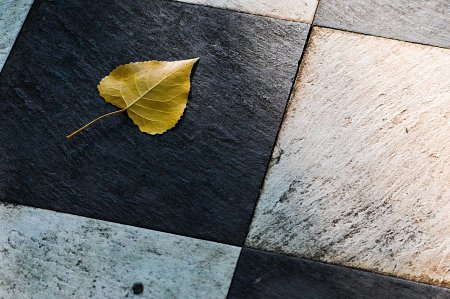
Limestone gives a smoother, more uniform surface than sandstone and suits contemporary garden designs, at £30-£60 per square metre for materials and £60-£110 installed. Dark blue-black varieties such as Kota Blue pair well with planting and timber fencing.
Absorption varies more widely than in any other natural stone here, from around 0.05% for dense Kota Blue to 5.58% for Portland limestone. High-density stone below 2% absorption performs reliably through British winters; softer, more porous varieties trap water and spall within a few seasons if left unsealed.
The calcium carbonate composition adds a second vulnerability. Acidic rainfall and unsuitable cleaning products etch the surface, causing permanent dulling and colour loss, and untreated dark limestone can fade from deep charcoal towards light grey. Sealing every 1-2 years with a breathable impregnating sealer is the shortest maintenance interval of the five materials, which is the commitment that comes with the finish.
Porcelain
Porcelain is the only material here that needs no sealing at all. Fired above 1,200°C from refined clays, fully vitrified porcelain achieves absorption of up to 0.5% under BS EN 14411 Group BIa, and some ranges are declared as low as 0.05%. With almost no water entering the tile body, there is no freeze-thaw mechanism to act on.
Maintenance is brushing and water every 6 to 12 months. The colour is fired into the body rather than applied to the surface, so it holds for 40-50 years, and textured finishes reach PTV 36-45 for outdoor slip resistance.
Cost and installation are the constraints. Materials run £30-£80 per square metre and installed costs reach £70-£130. Porcelain needs a full mortar bed over a solid sub-base rather than a sand bed, plus a slurry primer of cement and SBR or PVA applied to the underside of every tile to guarantee adhesion. A correctly bonded 20mm porcelain slab on a solid concrete base performs equivalently to a 35mm concrete slab in pedestrian use.
Concrete
Concrete is the budget option, from £10 per square metre for materials and £40-£70 installed, and it is also the most vulnerable to frost. Absorption of 5-7% against a BS EN 1339 limit of 6% for Class 2 flags means water sits in the cement paste, freezes and generates force that exceeds the local strength of the material. The result shows first as shallow spalling or shelling of the upper mortar layer and progresses to loss of that layer.
Efflorescence is the second recurring issue: soluble salts carried to the surface by evaporating water leave white crystalline deposits, most visibly in the first years after installation. Colour fade becomes apparent within 10-15 years without regular sealing, and expected lifespan is 20-30 years.
Sealing every 2-3 years is essential rather than optional. Modern textured and coloured ranges imitate natural stone convincingly, so concrete remains a functional choice where budget drives the decision, provided the shorter lifespan and the sealing schedule are accepted upfront.
Granite
Granite is the most durable paving material commonly available in the UK, with an expected lifespan of 75-100 years. Absorption of 0.2-0.5% and compressive strength of 130-240 N/mm² make it frost-proof without any sealing treatment. Published figures for UK-supplied granite include 0.20% for De Lank, 0.32% for Tarvos and 0.40% for Silver Grey.
Flamed and bush-hammered finishes give strong grip underfoot at an R11 slip rating, and the stone resists oil, grease, barbecue stains and chemical attack. Granite is UV-stable, so it does not fade, flake or absorb acid-rain deposits.
Materials cost £40-£100 per square metre and installed costs reach £80-£170, the highest of the five. That buys the lowest maintenance burden and the longest service life, which suits high-traffic areas, outdoor kitchens and urban courtyards.
What Each Surface Looks Like After Five Winters
Ranked from best preserved to most weathered after five British winters, the order is granite, porcelain, sealed Indian sandstone, sealed limestone, then concrete.
Granite is effectively unchanged, with no flaking, fading or surface loss. Porcelain remains colour-stable with no spalling and only minor algae in persistently wet spots. Sealed Indian sandstone carries a patina that most owners consider an improvement, alongside moss and algae in damp corners that need attention. Sealed limestone holds its colour reasonably well but shows etching where acidic runoff or the wrong cleaner has reached it. Unsealed concrete shows the most visible change: fade, efflorescence, surface wear and moss colonisation, much of it within the first decade.
Sealing and maintenance matter more than the stone type for every natural material here. A well-sealed quality sandstone patio outlasts a neglected concrete one by decades.
Which Material Needs the Least Maintenance?
Porcelain needs the least maintenance of the five, with no sealing, no specialist cleaners and no acid sensitivity.
| Material | Cleaning | Sealing | Overall burden |
|---|---|---|---|
| Porcelain | Brush and water, every 6-12 months | Not required | Very low |
| Granite | Brush and water, every 6-12 months | Every 3-5 years, optional | Low |
| Concrete | Pressure wash, every 6-12 months | Every 2-3 years | Moderate |
| Indian sandstone | Careful pressure wash, twice yearly | Every 2-3 years | Moderate |
| Limestone | Careful pressure wash, twice yearly | Every 1-2 years | Moderate to high |
Granite follows closely, with sealing optional rather than essential. Indian sandstone and limestone both need a committed routine: regular sealing, pH-neutral cleaning, controlled pressure washing and attention to moss and algae. Concrete sits between the two groups, cheaper to buy but dependent on consistent sealing to avoid early deterioration.
Which Material Offers the Best Long-Term Value?
Value here means years of satisfactory service per pound spent, counting both the installed cost and the maintenance that follows.
Indian sandstone gives the best value-to-performance ratio for most UK homes: £100-£150 per square metre installed, a 25-40 year lifespan and sealing that adds roughly £3-£5 per square metre per cycle every 2-3 years.
Porcelain costs £70-£130 installed and carries the lowest lifetime maintenance cost. Over a 40-year horizon, its total cost of ownership can undercut sandstone once sealing cycles are priced in.
Granite costs the most to install at £80-£170 but lasts 75-100 years, so the cost per year of service is the lowest of the five. The initial outlay is what puts it beyond many domestic budgets.
Limestone sits mid-range at £60-£110 installed with a 30-50 year lifespan, and carries the heaviest maintenance load of the natural stones because of the 1-2 year sealing interval and acid sensitivity.
Concrete is cheapest to install at £40-£70 but has the shortest lifespan and the tightest maintenance schedule. Across 30 years, resealing plus eventual replacement erodes most of the initial saving.
Which Patio Material Should You Choose?
The decision comes down to budget, the look you want and how much maintenance you will actually do.
Choose Indian sandstone paving slabs for natural character at an accessible price, accepting a sealing cycle every 2-3 years. Choose porcelain if you want a fit-and-forget surface with no sealing and stable colour for decades. Choose granite for a premium installation that will outlast the rest of the garden. Choose limestone for a contemporary dark-toned finish, with the most attentive maintenance of any stone here. Choose concrete when budget is the deciding factor and a 20-30 year service life is acceptable.
For most British gardens the realistic shortlist is sandstone or porcelain. Both survive British winters for decades when correctly specified, installed and maintained.

