

A press release says revenue grew 12% in the third quarter. You run it through a rewriting tool to loosen the tone. The output reads beautifully, and now revenue “nearly doubled” over the year.
Nobody notices until a client does.
That’s the quiet risk with AI rewriters. Everyone argues about whether the output passes a detector. Far fewer people check whether it still says what the original said, and the early numbers suggest they should.
What Counts as a Hallucination in a Rewrite
When a chatbot invents a court case, that’s a hallucination. In a rewrite, the problem is subtler. The tool isn’t generating from scratch. It’s supposed to keep every claim and change only the wording. A hallucination here is any unsupported factual change slipped in along the way.
The usual suspects
Most of the damage falls into a few patterns:
- Numbers that shift, round, or swap units
- Hedges that vanish, so “may reduce” becomes “reduces”
- Names, dates or places replaced with near neighbors
- Cause and effect quietly reversed
- New “facts” added to make a sentence flow
The second one is sneaky. Drop the word “may” from a medical or financial claim and you haven’t just changed style. You’ve changed what the writer is promising.
What the Measurements Show
Hallucination counts across four tools
In September 2026, Phrasly ran a test of four humanizer tools on 72 AI-written texts averaging 761 words, published on its Benchmarks page. Phrasly makes one of the tools, which is worth keeping in mind. Unusually, though, the test didn’t stop at detection scores. It counted unsupported factual changes in every output.
The results were rough across the board:
| Tool | Average hallucinations per output | Outputs with zero hallucinations |
| Phrasly Ultra | 0.85 | 48.6% (35 of 72) |
| WriteHuman | 2.64 | 14.5% (10 of 69) |
| StealthGPT | 3.54 | 5.6% (4 of 71) |
| Undetectable AI | 6.16 | 1.4% (1 of 70) |
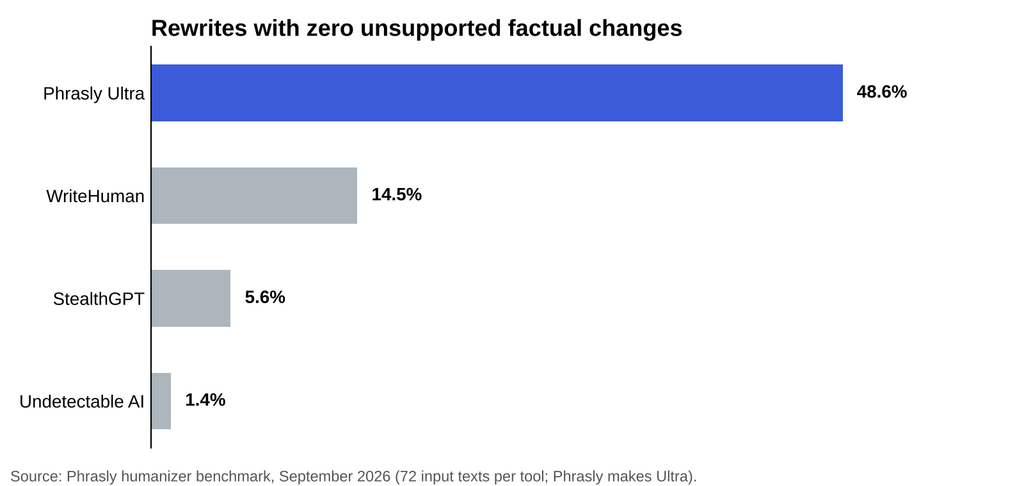
Share of rewrites with zero unsupported factual changes. Source: Phrasly humanizer benchmark, September 2026 (72 input texts per tool).
Read that bottom row again. Six factual changes per output, on average, in texts of roughly 760 words. That works out to about one every 125 words.
And look at the top row with the same care. The best performer still introduced at least one hallucination in 51.4% of its outputs. The benchmark page says as much itself, framing “fewest hallucinations” as a relative claim rather than a clean bill of health. That’s the honest reading.
A vendor’s own number
StealthGPT has published a figure too. Its evaluation of the Super model reported an 82% pass rate on factual consistency, meaning 18 of 100 outputs failed (RuntimeWire, September 2026). That’s self-reported, with limited detail on method. Even so, it points the same way: nearly one in five rewrites changed something it shouldn’t have.
Why rewriting invites errors
There’s a mechanical reason for this. Detectors pick up on predictable phrasing, so tools built to evade them push toward less predictable word choices. Less predictable often means less precise.
Research on paraphrasing backs up the trade-off. Krishna and colleagues showed in 2023 that a paraphrase model called DIPPER could cut one detector’s accuracy from 70.3% to 4.6% at a 1% false positive rate, while keeping meaning close for most outputs (NeurIPS 2023). Most is not all. And commercial tools tuned hard against today’s detectors may be pushing further than a research model ever did.
A September 2026 preprint from Beihang University adds another wrinkle. It found that rephrasing a question without changing its meaning was enough to flip correct model answers to wrong ones, in some setups up to 55% of the time. Language models are sensitive to wording in ways that don’t always protect facts.
The academic warning sign
Science publishing already has a name for what crude rewriting does to meaning: “tortured phrases.” Think “counterfeit neural organization” in place of “artificial neural network.” Researchers led by Guillaume Cabanac have found around 19,000 papers containing at least five such phrases, and their screening work has contributed to more than 1,000 retractions (The Conversation, January 2025). Not every case traces back to a paraphrasing tool. But the lesson carries over. When a tool swaps words without understanding them, meaning breaks.
What drift looks like on the page
Here’s a made-up but typical example. The original sentence reads: “The pilot program, launched in 2024, may reduce onboarding time by up to 30% for teams of roughly 50 people.”
A heavy rewrite comes back as: “Launched last year, the pilot cuts onboarding time by 30% for teams of 50.”
It sounds cleaner. It’s also wrong in three places. “Last year” depends on when you read it. “May reduce” became “cuts,” turning a possibility into a promise. “Up to 30%” became a flat 30%, and “roughly 50” became exactly 50. Not one of those changes would trip a spellchecker or a grammar tool, and none would matter to a detector. Every one of them matters to a reader making a decision.
Multiply that by a dozen sentences in a sales deck or a research summary and you can see how six changes per document stops being an abstract statistic.
How to Check a Rewrite Before It Goes Out
You don’t need a lab to catch most of this. You need a routine.
Diff the facts, not the words
Before rewriting, list every number, name, date and claim in the original. After rewriting, tick each one off. This takes five minutes for a 1,000-word piece, and it catches the worst errors.
Hunt for missing hedges
Search the original for “may,” “could,” “about,” “roughly” and “up to.” Then find each one in the output. If it’s gone, decide whether the stronger claim is actually true.
Read the claims out loud
Odd synonyms and reversed logic jump out when you hear them. “Faucet your account” sounds wrong in a way it may not look wrong.
Use an automated check as a second pass
Factual consistency metrics like AlignScore, a 355-million-parameter model trained on 4.7 million examples, can score how well one text is supported by another (Zha et al., ACL 2023). They won’t replace your judgment. They will flag the paragraphs that deserve a second look.
Weigh the stakes
A rewritten Instagram caption with a slightly off adjective is harmless. A rewritten product spec, legal summary or grant report with a changed number isn’t. Match your checking effort to the cost of being wrong.
What to Ask a Tool Before You Trust It
If you’re choosing a rewriter, add one question to your shortlist: does the company publish any measure of factual accuracy at all? Most don’t. Detection rates get the headlines because they’re easy to show off in a screenshot. Factual drift is harder to measure and less flattering.
Worth noting, too, what’s still missing. There’s no large, independent, peer-reviewed study yet that measures factual drift across commercial humanizers. What exists comes from vendors, including the two figures above. That makes it more important, not less, to read the methods and check your own outputs.
Accuracy Is the Part You Can’t Outsource
A rewriting tool can help a stiff draft sound like a person wrote it. What it can’t do, on current evidence, is promise that every fact survives the trip. Even the strongest result in the most detailed test available left errors in about half the outputs.
So treat a rewrite as a draft, not a finished piece. Check the numbers. Restore the hedges. Read it once more with the original open beside it. That habit costs a few minutes, and it protects the one thing your readers actually care about: whether what you told them is true.

