


Imagine three businesses on the same British high street: a shop reading reviews, a restaurant comparing nearby menus and a studio looking for local creators. These are hypothetical examples, not reported cases. Each has material to sift through, but none needs a machine to make the final marketing decision. AI agents for small business are useful when they follow a bounded task, use permitted sources and hand back an inspectable draft.
What each owner needs to decide:
- Shop: group recent review themes; decide which complaint deserves investigation.
- Restaurant: compare dated public menus; decide which differences matter.
- Studio: shortlist creators; decide whom to approach.
- Any business: check sources, permissions and stopping points before repeating the task.
Further reading before the first task
Start with one question, such as whether recent reviews mention missing stock more often than delivery. Specify the permitted sources, date range and output. A table of source, date, observation and unresolved question is easier to check than a recommendation with no evidence trail.
Owners seeking background on bounded workflows can use practical guides on AI agents for small teams as further reading. The blog covers AI agents and workflow automation for small teams. On the first run, collect the material, draft a summary and stop before a public reply, price change or creator contact.
AI agents for small business: what reviews reveal
At the hypothetical shop, the owner has permission to view recent public reviews. A useful first pass groups comments by the issue described and keeps a link or reference to each original. “Delivery”, “stock” and “service” might be starting labels, but a complaint about a missing item should not be forced into a delivery problem simply because it mentions a courier.
Suppose a draft says stock availability is the leading issue. Before changing a product page, the owner checks how many reviews were examined, when they appeared and whether several comments concern one incident. A few vocal customers may point to a problem worth checking; they cannot describe every customer’s experience. The owner should treat the draft as a question to check before anyone writes a public reply.
Review text may contain names or other personal details. An initial theme count using information stripped of identifiers is a more cautious input than copying whole customer profiles into a new tool. The UK’s Information Commissioner’s Office says organisations processing personal data with AI need an appropriate lawful basis; the right handling depends on the specific use. The shop should check what its chosen tool receives before sharing the material.
A restaurant uses menus as a question, not a verdict
The restaurant can inspect a rival’s public menu and its own current offer. A comparison is only useful if the owner records when each page was viewed and whether a listed price refers to the same portion, meal period or add-ons. An agent could produce a side-by-side draft, flag missing details and keep the menu links. If a menu is undated or unavailable, leave that field blank rather than guessing.
| Observation | What it may show | What it cannot show |
| A nearby menu lists a lower headline price | The displayed offers differ on the dates checked | Which restaurant has higher margins |
| A rival offers a lunch bundle | A particular bundle is being advertised | Whether customers prefer it |
The manager checks actual portion sizes, costs and customer requests. A lower advertised price alone is a poor reason to cut a price. It might instead prompt a clearer explanation of the restaurant’s lunch offer. This is competitor analysis as a source-backed question, not a verdict from a screenshot.
Choose a tool by its inputs and stopping point
The simplest version needs no specialist agent: the owner reads the original pages and keeps a spreadsheet. An authorised export may be enough for a repeatable task. AI marketing tools become worth testing when the input, draft and human review are clear.
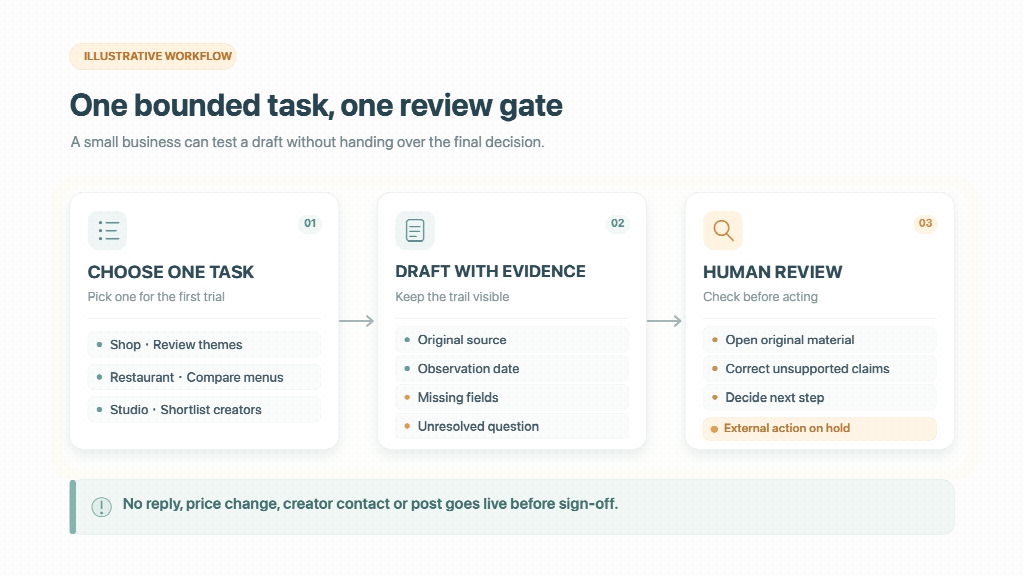
Illustrative workflow: a small business chooses one marketing task, reviews a source-backed draft and keeps external action on hold until human sign-off.
SpringBrand describes APIs and plugins for go-to-market work, including market research, competitor analysis and social media workflows. That makes it one possible connection route for an agent, alongside manual checks or other authorised tools. Its broad categories do not confirm that it can access a particular shop’s private reviews, every UK restaurant menu or a studio’s preferred creator accounts. Test the actual source, permission and output before relying on it.
Begin with read-only access where possible. Ask the tool to retain the original URL or file name, observation date and any missing fields. Keep sending messages, publishing posts and changing prices outside the agent’s authority during the trial. If a source disappears or the draft cannot be traced back to one, stop that run and inspect it instead of allowing the system to fill the gap with plausible text.
A studio builds a creator shortlist
For the hypothetical studio, a large follower count says little about whether a creator reaches people in the studio’s area or makes work suited to its services. The first list can record publicly visible content topics, location clues and recent partnership labels, with links to the posts that support each entry. If the audience’s location is not public, mark it unknown. Do not turn a profile’s stated city into a claim about where its followers live.
The owner compares candidates against the studio’s brief and inspects recent posts. A shortlist identifies who merits a closer look; it is no evidence of partnership interest or likely sales. Handle contact details and personal data for the intended use, rather than copying them into an unrestricted file.
If a paid or otherwise commercial collaboration follows, the studio and creator need to consider how the resulting material is identified as advertising. ASA/CAP guidance says brands and influencers share responsibility for making ads obviously identifiable; a clear, prominent “Ad” label is generally appropriate. A person should check the arrangement and final post against the current guidance. Leave disclosure approval to that person; the agent only flags the question.
Run one week of checks before expanding
Choose just one of these jobs for an initial week. Give the agent a narrow source list and a draft format. Nominate the person who checks the originals. Record each missing source, wrong grouping and unsupported suggestion, along with the time spent correcting it. That record shows whether marketing automation actually saves this business time.
A small trial needs a clear stop rule:
- Stop if the source cannot be reopened or dated.
- Stop if the tool uses data the business has not cleared for this purpose.
- Stop before any reply, price change, contact or post goes live.
- Compare the corrected draft with the original material before another run.
If the corrections take longer than the manual check, narrow the task or use the spreadsheet instead. If the draft repeatedly gives the reviewer a reliable starting point, keep the same human sign-off and expand only one source or action at a time. Then pick the single question the business will ask the system next week, and decide what evidence must come back with the answer.

